


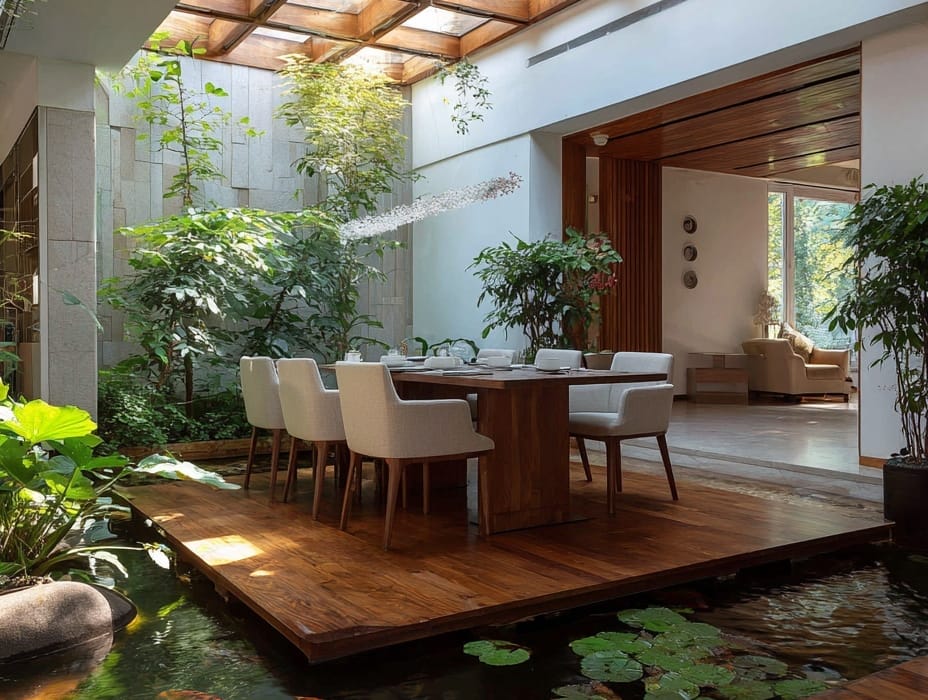

Generative AI is no longer limited to creating flat images. Modern models are increasingly capable of producing complex assets crucial for building immersive virtual environments, particularly seamless textures and realistic material maps.
For game developers, architects, and VR creators, integrating these tools drastically cuts down on asset creation time.
The asset generation pipeline
Generating assets for 3D modeling requires more than just a single image. You need several specialized maps—like albedo, normal, and roughness—that define how light interacts with the material in a 3D environment.
- Albedo Map: The base color and texture of the material (e.g., the visible stone).
- Normal Map: Defines the surface irregularities and bumps, making the surface appear three-dimensional without adding complex geometry.
- Roughness/Metallic Map: Determines how shiny or matte the surface is, controlling reflections.
You prompt the AI for the base texture (e.g., wet mossy cobblestone path) and then use specialized tools within platforms like Leonardo AI or dedicated third-party software to automatically generate the corresponding maps.
Creating seamless, tileable textures
A fundamental requirement for 3D textures is that they must tile seamlessly. This means the edges of the image must perfectly match up when repeated, preventing visible seams in the final 3D model.
Cita
"The secret to realism in a 3D environment is the complexity of the normal map. AI provides that detail instantly."
Many AI generators now include a specific parameter or mode (e.g., --tile in Midjourney) that forces the output to be tileable, which is a massive time-saver for artists.
Code
// Prompt for a tileable texture
Seamless texture of dark, pitted alien metal, industrial environment, highly detailed, photorealistic, **tileable**
Integrating with game engines
The final step is getting the generated maps into software like Blender, Unity, or Unreal Engine.
The workflow of integration
The AI-generated maps (usually exported as PNG files) are imported directly into the material editor of the game engine. You then connect the Albedo map to the Base Color input, the Normal map to the Normal input, and so on.
This immediate pipeline allows rapid prototyping and iteration on environment design. Avoid using textures with embedded text or logos in your final game assets.
The ability to generate custom, high-resolution textures in minutes—instead of hours of manual sculpting—has fundamentally changed the landscape of 3D asset creation. You can find more information about asset generation techniques onThe Gamedev Texturing Guide.
Comments